 RugSnap
Antique identifier app: identify and value antiques from a photo
Last updated 4 November 2026
The short answer. RugSnap is an antique identifier app that works from photos: it says what a piece probably is, its era and origin, any marks it can read, and a value range with the market it rests on. Two appraisals are free, in any modern browser. It is an estimate, not a certified appraisal, and never a verdict on authenticity.
Identify an antique from photos, free
What the antique identification app gives you
RugSnap is an antique identifier AI app: photograph the piece and it returns one answer, the same in the web app and the iPhone app.
- What it is. A plain name that holds only what the photos settle. A maker, workshop or region it is less sure of comes separately, as probable or possible.
- Era and origin. When and where the piece was probably made.
- Maker clues. Any signature, hallmark, label or inscription it can read, transcribed in the details, or marked partly legible rather than guessed.
- A value range with its basis. In US dollars, labelled as the price new, a realistic resale price or the collector market, with why the range is what it is and what moves it.
- How sure it is. High, medium or low confidence, and what limits it.
- The one extra photo that sharpens it. The shot that would change the answer most: the underside, a mark, the back of a rug. Add it and the same piece is checked again; the first re-check of a new appraisal, made within 30 minutes, is free.
- A flag on restricted materials. Ivory, tortoiseshell and other protected materials common in antiques are flagged, so you can check the rules before you sell.
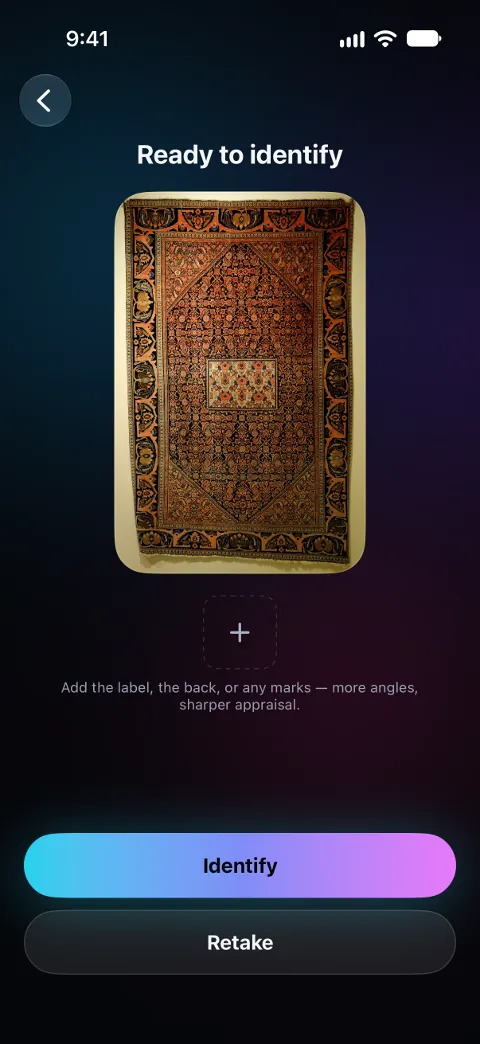
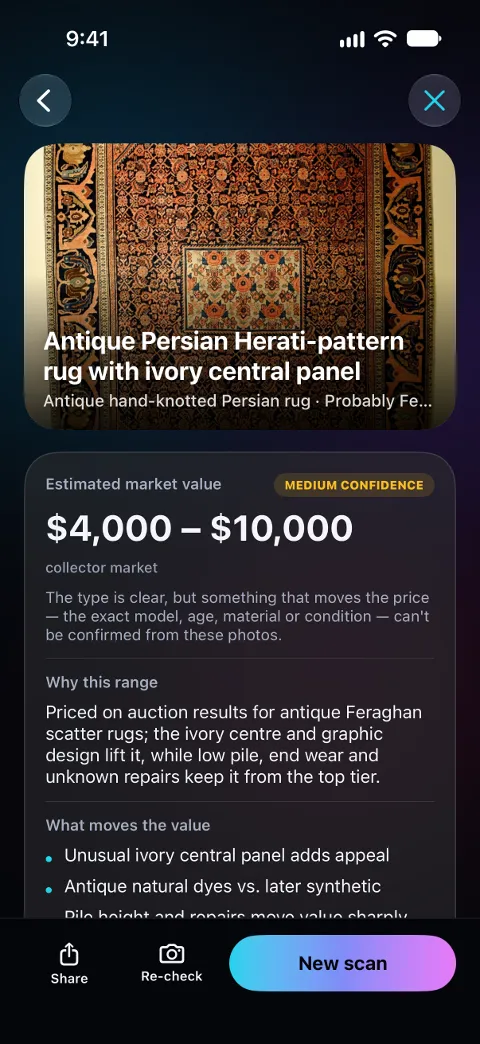
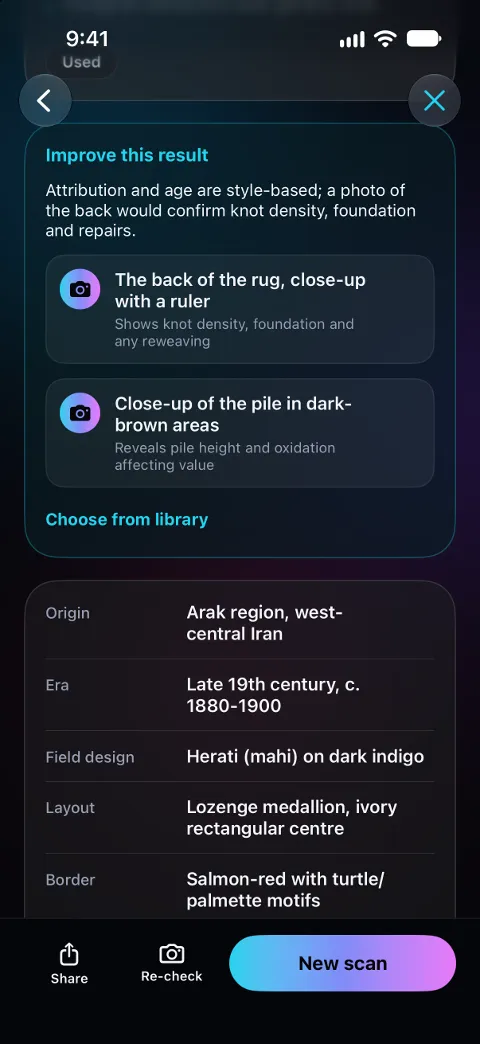
Real screens from RugSnap's iPhone app, from one appraisal of an antique Persian rug. The range is RugSnap's estimate from the photos, not an appraisal.
A free app to find the value of items, not only antiques
The same app values almost any physical object with a market. RugSnap's homepage names the range: paintings and calligraphy, samovars and jewelry, game consoles and cameras, sneakers and trading cards, as well as rugs, watches, phones, furniture and books. Each answer is shaped by the kind of object, such as the reference of a watch, the medium and signature of a painting or the style code of a sneaker, and ends in a value range with its basis: the price new, a realistic resale price or the collector market. The two free appraisals cover any item, in any modern browser, Android included; there is no Android app.
What it cannot do
- It cannot authenticate. A photo can show signals worth checking, never prove that a piece is genuine rather than a reproduction. RugSnap reports what it sees as signals, and even Sotheby's and Bonhams call an estimate made from photos preliminary until the piece itself is examined.
- It is not a certified appraisal. A ballpark figure to satisfy curiosity needs no appraisal. Insurance, probate or a deduction for a valuable donation does: a written appraisal by a qualified appraiser. Where to get antiques appraised compares the ways to get one.
- It cannot see what the photos leave out. The weight, the inside of a drawer, a repair under the base: whatever is not in frame is not in the answer.
- It does not search live listings. The range comes from what the AI model knows of the market, which stops at a cutoff date. For a figure that matters, check recent sold prices: the antique price guide shows where.
How to photograph antiques for an identification
Better photos get a better answer. Auction houses ask for much the same as RugSnap does:
- The whole piece, front and backOr top and bottom, in natural light without glare, against a plain background.
- Every mark, close upA signature, a maker's mark, a label or a stamp, sharp enough to read: that is where the value often hides.
- Condition, honestlyChips, cracks, repairs and replaced parts. Condition moves the value, and auction specialists weigh it.
- Up to four photos, appraised togetherRugSnap treats them as one piece seen from several angles, and tells you which extra shot would help most.
How to photograph it for an appraisal goes object by object.
Choosing an antique identifier app: what to check
Whether you want the best free antique identification app or a paid antique valuation app, ask any of them the same questions before you trust its number.
| Ask | Why it matters | RugSnap's answer |
|---|---|---|
| Does it say what the value is based on? | Auction, retail and insurance values for one piece are different numbers | Every range names its market and says why it is what it is |
| Can you check it against sold prices? | A sold price is evidence; an asking price is a hope | It names the market and the comparable it priced from, but searches no live listings |
| Does it say how sure it is? | Look-alikes and reproductions make some pieces hard to place | High, medium or low confidence, and the photo that would raise it |
| Where do your photos go? | Photos of your things can show your home | No account; RugSnap does not store them, and the AI provider normally deletes them within 30 days |
| What does it cost after the free part? | Free tiers end, and subscriptions renew | Two free appraisals, then Pro, below |
| Does it promise what a photo cannot do? | No app can authenticate an antique or replace a written appraisal | No verdicts on authenticity, and an estimate, not a certified appraisal |
An antique finder app or antique pricing app that answers all six plainly is one you can check; one that shows a single confident price with no basis is one you cannot.
Free antique appraisal app, then Pro: what it costs
| Plan | Price | Where |
|---|---|---|
| Free | Two appraisals per device, with no account | This website and the iPhone and iPad app |
| Pro, yearly | $39.99 a year, after a one-week free trial for eligible new subscribers | This website and the iPhone and iPad app |
| Pro, monthly | $9.99 a month | The iPhone and iPad app |
| Pro, weekly | $6.99 a week | The iPhone and iPad app |
Prices are in US dollars. Pro puts no quota on appraisals, under a fair-use policy, and renews until you cancel; the trial turns into the paid yearly plan unless you cancel at least 24 hours before it ends. The iPhone and iPad app is coming soon to the App Store.
Free antique identification app for Android? Use the web app
RugSnap has no Android app. On an Android phone, open rugsnap.app/app in Chrome or any other modern browser and take or upload your photos there: the appraisal is the same, and so are the two free ones. To keep it one tap away, open Chrome's More menu and choose Install and create shortcut, which puts it on your home screen.
Get the ballpark, usually in under a minute. Photograph the piece and RugSnap tells you what it is, its era, the details that matter for that kind of object, and a value range with its basis stated. Two appraisals are free, with no account, in any modern browser, Android included. It is an estimate, not a certified appraisal, and it never declares an antique genuine or fake.
Identify an antique from photos
Questions people ask
Is there a free antique identifier app?
Yes. RugSnap gives every device two free appraisals, with no account, in any modern browser. Each one names the piece, its likely era and origin, and a value range with the market it rests on. After that, RugSnap Pro is a subscription.
Is there a free app to find the value of items?
Yes. RugSnap's two free appraisals work for almost any physical object with a market, not only antiques: paintings, jewelry, watches, cameras, game consoles, sneakers and trading cards among them. It runs in any modern browser, Android included; there is no Android app. After the free appraisals, RugSnap Pro is a subscription.
What is the best antique identifier app?
The one whose answer you can check. It should say what its value is based on, how sure it is and what a photo cannot show, and its price should hold up against recent sold prices. No app can authenticate an antique from photos.
Can an app tell if an antique is real?
No. A photo can show signals worth checking, such as marks, construction and wear, but it cannot prove a piece genuine. Even auction houses treat estimates from photos as preliminary until a specialist examines the piece. RugSnap reports signals, never a verdict.
Is there a free antique identification app for Android?
RugSnap has no Android app, but its web app works in Chrome or any other modern browser on Android, with the same two free appraisals. Chrome can also add it to your home screen.
How accurate is an antique appraisal app?
As accurate as the photos and the market allow. RugSnap gives a range rather than one price, says how confident it is and why, and asks for the photo that would help most. Treat it as a first estimate and check it against recent sold prices.
Can I use an app appraisal for insurance?
No. For insurance, probate or a deduction for a valuable donation you need a written appraisal by a qualified appraiser. An app estimate tells you whether paying for one is worth it.
Does RugSnap keep my photos?
No. RugSnap does not store the photos it appraises. Anthropic, which runs the AI, normally deletes them within 30 days and may not train its models on them, and your history stays on your own device.
Related
Sources
Every number, fee, legal point and test claim on this page rests on two or more of these public sources; what RugSnap does and costs rests on its own published terms and pages, which say the same thing in more than one place. All were checked on 3 November 2026.
RugSnap's own terms and pages
- RugSnap, the homepage: pricing and FAQ. Two free appraisals on every device, with no account; RugSnap Pro at $6.99 a week, $9.99 a month or $39.99 a year, the yearly plan after a 1-week free trial for eligible new subscribers; the website sells only the yearly plan, and the weekly and monthly plans are for the iPhone and iPad app; plans renew automatically until cancelled, and the trial becomes the paid yearly plan unless cancelled at least 24 hours before it ends; every estimate states a confidence level and a value basis. Checked again on 4 November 2026 for the objects it names: paintings and calligraphy, samovars and jewelry, game consoles and cameras, sneakers and trading cards (the “Not just rugs” card), and rugs, antiques, watches, laptops and phones, fragrance, cosmetics, furniture, instruments, books and household goods (the FAQ).
- llms.txt, RugSnap's summary for answer engines. Identifies almost any object from one to four photographs, appraised together; states a value range and its basis (new retail price, realistic resale value or collector-market price); reports authenticity signals, never a verdict; flags CITES materials such as ivory and tortoiseshell in antiques; tells you which additional photograph would sharpen the answer, and the first re-check of a new appraisal, made within 30 minutes, is free; two free appraisals per device; Pro at $6.99/week, $9.99/month, $39.99/year, with a free trial on the yearly plan; RugSnap does not keep the photos it appraises and the AI provider normally deletes them within 30 days; runs in any modern browser.
- Terms of Use, RugSnap, updated 3 November 2026. An appraisal is an AI estimate, not a certified or professional valuation for insurance, tax, probate or lending, and not proof that an item is genuine; Pro puts no quota on appraisals under fair-use limits; subscriptions renew until cancelled; the free trial is one week on the yearly plan, for eligible new subscribers, and must be cancelled at least 24 hours before it ends.
- Support, RugSnap. The yearly plan includes a one-week free trial for eligible new subscribers; RugSnap tells you which extra shot would help most, and adding it within 30 minutes re-checks the same item once without using another scan; photos are not kept, and Anthropic, which runs the AI, deletes them within 30 days and may not train its models on them.
- Privacy Policy, RugSnap. No account is needed; up to four photos of the same item are sent for each appraisal; RugSnap does not store them; Anthropic deletes these inputs and outputs within 30 days and may not train its models on them; scan history stays on your device.
Anthropic, the AI provider
- How long do you store my organization's data?, Anthropic Privacy Center, 1 July 2026. For Anthropic API users, inputs and outputs are deleted automatically within 30 days of receipt or generation, except where a longer period is agreed or chosen, needed to enforce Anthropic's Usage Policy, or required by law.
- Commercial Terms of Service, Anthropic, effective 17 June 2025. Anthropic may not train models on Customer Content from its Services.
Auction houses and appraisers
- Is my estimate a final appraisal of value?, Sotheby's Help Center, updated 18 September 2023. Its estimates are not a formal appraisal; they are preliminary, subject to examination of the item; formal documents for insurance, tax or estate valuations come from its Valuation Services.
- What do I need to request an estimate for my item?, Sotheby's Help Center, updated 2 April 2026. Photos of the entire item, front and back, and of its condition and any unusual markings, with a close-up of a signature; natural light to avoid glare; a neutral or white background for most objects.
- How are estimates determined?, Sotheby's Help Center, updated 1 October 2026. Specialists weigh the artist or maker, country of origin, provenance, date, materials, dimensions, rarity, subject or type and condition, and comparable sales.
- Sell with Bonhams: Request a Free Auction Estimate, Valuation or Appraisal, Bonhams. Photos of the front and back or top and bottom, with any signatures and certificates of authenticity; auction estimates based on photographs are preliminary only and may change after first-hand inspection; Bonhams gives no warranty as to an item's origin, attribution, condition, date, age or authenticity.
- Understanding Our Appraisals, Antiques Roadshow, PBS. Experts give values in context, at auction, retail or for insurance (replacement value); an appraisal is a legal document, generally for insurance, written by a qualified expert and paid for by the owner.
- Explainer: What's the Deal with Values?, Antiques Roadshow, PBS, 29 April 2016. An antique has an auction value, a retail value and an insurance value; for ordinary pieces auction prices are usually lower than retail; insurance values tend to be set at the top end of retail and are issued as formal written appraisals.
- FAQs, American Society of Appraisers, Philadelphia Chapter. No appraisal is needed for a rough ballpark estimate to satisfy curiosity; one is needed for insuring, probating a will, a divorce and other cases that need an estimate you can rely on; an appraisal is a written opinion of value by a qualified appraiser.
Tax and valuation
- Publication 561, Determining the Value of Donated Property, Internal Revenue Service, revised December 2025. A deduction of more than $5,000 for donated art and collectibles must be supported by a qualified appraisal by a qualified appraiser; the best evidence of fair market value is actual transactions, not an artificial estimate; a dealer may sell an item for much less than its listed price; the physical condition and extent of restoration bear on the value of antiques.
- 26 U.S.C. § 170(f)(11)(C), via Cornell Law School's Legal Information Institute. For donated property for which a deduction of more than $5,000 is claimed, the donor must obtain a qualified appraisal.
Protected materials
- 50 CFR § 17.40(e), via Cornell Law School's Legal Information Institute. In the United States, selling African elephant ivory in interstate or foreign commerce is prohibited, except antiques and certain items with de minimis quantities of ivory.
- Deal in items made of or containing ivory, GOV.UK. In the UK, buying, selling or hiring out an item made of or containing elephant, hippopotamus, killer whale, narwhal or sperm whale ivory needs an exemption under the Ivory Act 2018.
- Hawksbill turtle, NOAA Fisheries. The hawksbill's shell, known as tortoise shell, is made into jewelry and trinkets; the species is listed in Appendix I of CITES, which forbids international trade in turtle products, hawksbill tortoise shell included.
- Hawksbill sea turtle, U.S. Fish and Wildlife Service. The hawksbill is protected under the Endangered Species Act throughout its range; its decline is due mainly to exploitation for tortoiseshell, and the legal trade in its shell ended in 1993, while an illegal trade continues.
Android
- Use web apps, Google Chrome Help (Android). Open Chrome, go to the website, tap More, then Install and create shortcut, then Install; an installed web app is reached from the launcher or the home screen.
- Create shortcuts for websites in Chrome, Google Chrome Help (Android). A shortcut to a website can be created on the device's homepage: open Chrome, go to the website, tap More, then Install and create shortcut, then Create shortcut.