 RugSnap
How to tell if gold is real: tests you can do at home
Last updated 4 November 2026
The short answer. No home test proves gold is real. Read the stamp, then weigh a plain piece in water on a 0.01 g scale: its density should match the stamp. Magnet, lighter, vinegar, water and toothpaste tests catch only crude fakes; plated jewelry passes most. A jeweler's XRF scan reads the surface alloy; a fire assay settles it.
Read a hallmark from a photo, free
Read this before you trust a test. Gold-plated brass can carry a carat stamp, and brass is not magnetic, so it passes the two checks most guides put first. If those are the only two you run, you have learned only that the piece is not strongly magnetic.
How to test gold at home: every test ranked by what it proves
Twelve gold testing methods for telling real gold from fake gold, from the one that settles it to the ones that settle nothing. The first three need a professional or a kit.
| Test | What it proves | What it cannot prove |
|---|---|---|
| Fire assay (assay office or refiner) | The gold content, weighed: the most accurate method | It destroys the sample |
| XRF scan (jeweler or dealer) | The alloy at the surface, without harm to the piece | What lies under thick plating |
| Acid kit and touchstone | Roughly the carat of the metal rubbed off | Anything below the surface; it scratches the piece |
| Density, weighed in water | Whether the whole piece is as dense as its stamp claims | A tungsten core; hollow and stone-set pieces read low |
| Wear at the edges | Plating, when another metal shows through | Anything, on a piece that has barely been worn |
| Stamp or hallmark | What the maker claims; a full UK hallmark means an assay office tested it | Stamps are faked |
| Magnet | A strong pull means a magnetic metal: not solid gold | Brass, copper and tungsten are not magnetic either |
| Ceramic gold test (streak) | A black streak: not solid gold | A gold streak: plating leaves one too |
| Float in water | If it floats, it is not solid gold | Sinking: almost every fake sinks too |
| Vinegar | A color change: base metal at the surface | No change: plated jewelry does not react either |
| Lighter | Blackening: base metal at the surface | Staying bright: plating does too, and real low-carat gold can darken |
| Toothpaste | Nothing about the metal | Anything: it polishes, and fakes stay shiny |
How to spot real gold: the density test, with the actual numbers
The gold density test is one of the most reliable home tests, because it measures the whole piece, not just its surface. You need a jewelry scale that reads to 0.01 g, a small, light cup of water and some thin thread. Keep the cup and its water well within the scale's capacity.
- Weigh it dryWrite the weight down in grams. This is the dry weight.
- Measure its volume on the scalePut the cup on the scale and press tare. Hold the thread and lower the piece until it is fully under water, touching neither the bottom nor the sides; shake off any bubble. The reading, in grams, is the piece's volume in cubic centimeters: the scale now carries the weight of the water the piece displaces, and a cubic centimeter of water weighs one gram.
- Divide the dry weight by that numberThat is the density, the figure a specific gravity test of gold gives. Compare it with the table below.
Why a measuring jug cannot do this. A 5 g ring of 14 carat gold has a volume of about 0.4 cm³, and a brass ring of the same weight about 0.6 cm³: a difference of 0.2 cm³, far too little to see on a kitchen jug.
| Metal | Density (g/cm³) |
|---|---|
| Pure gold (24K / 999) | ≈ 19.3 |
| 22 carat (916) | ≈ 17.7 |
| 18 carat (750) | ≈ 15.6 |
| 14 carat (585) | ≈ 13.1 |
| 9 carat (375) | ≈ 11.2 |
| Sterling silver | ≈ 10.4 |
| Brass, a common base for fakes | ≈ 8.5 |
Gold figures are typical yellow alloys; the exact number depends on the metals mixed in.
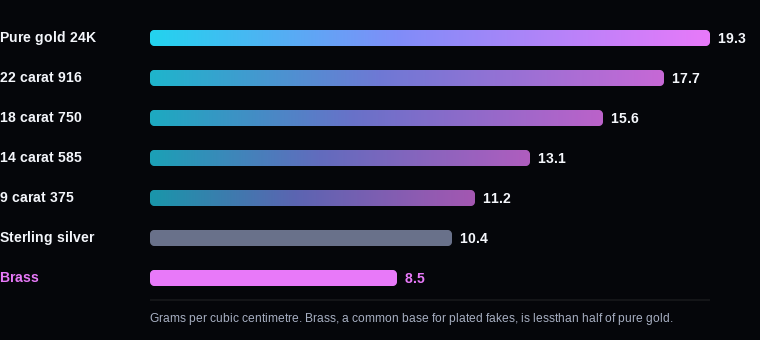
Proves: whether the whole piece is as dense as its stamp claims: a piece stamped 585 that measures about 8.5 has the density of brass. Cannot prove: that a match is gold. Tungsten is about as dense as gold, so a gold shell over it passes; hollow pieces read low; set stones are far lighter than gold (a diamond is about 3.5). Use pieces of 3 g or more, and 10 g or more to tell 14 carat from 18. The gold density calculator does the division and the comparison for you.
How to identify gold at home with water and salt: what density can and cannot show
The quick water test: drop the piece into a glass. Solid gold sinks at once.
Proves: a piece that floats is not solid gold. Cannot prove: that a piece that sinks is gold. Brass, lead and tungsten sink quickly too; the float test catches only hollow pieces and very light metals.
Salt changes nothing for a solid piece: dissolved salt makes water denser, but the metals in the table above are eight to nineteen times as dense as water. The water test that works is weighing in water, above. It shows a piece far too light for its stamp; it cannot see a tungsten core, a risk mostly with bars, which dealers check with ultrasound.
The lighter (flame) test
To check real gold with a lighter, hold the piece in tweezers and play the flame on a hidden spot for a few seconds. Gold does not tarnish, and it melts only at about 1,064 °C; many base metals darken.
Proves: a piece that blackens quickly has base metal at its surface. Cannot prove: that a piece that stays bright is gold. Plated and gold-filled jewelry stays bright in a brief flame too, and real lower-carat gold contains copper, which can leave a black oxide layer when heated. Heat can also damage stones and solder, so skip it on anything set or valuable.
Toothpaste and vinegar tests: what they really show
Toothpaste. How to test gold at home with toothpaste: rub it on the piece and rinse, and real gold should stay bright. Toothpaste is abrasive, so you are really polishing.
Proves: nothing about the metal. Cannot prove: anything: real gold stays shiny, and so do many fakes. On plated jewelry the rubbing wears away the layer you are judging.
Vinegar. Put a few drops of white vinegar on the piece, or soak it for a few minutes. Gold is unaffected by mild acids; some base metals change color.
Proves: a piece that changes color, fizzes or turns green has base metal at its surface. Cannot prove: that a piece that does not react is gold: plated jewelry does not react either, nor do many fakes.
How to tell if your jewelry is real gold: stamps and plating wear
How do you identify real gold? Read the stamp first
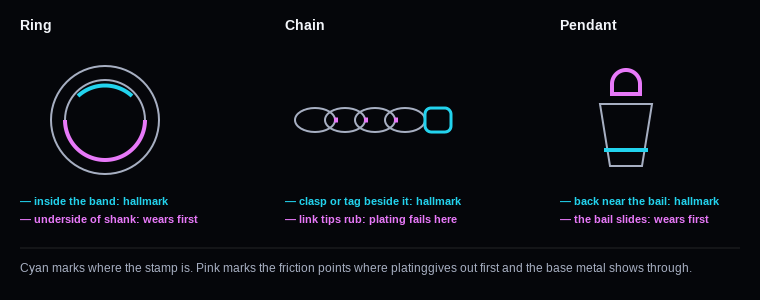
Look inside a ring band, on a clasp or on the back of a pendant, with a loupe or a phone's macro lens. The number is purity in parts per thousand; carat marks say it in 24ths:
| Number | Carat | Gold content |
|---|---|---|
| 375 | 9K | 37.5% |
| 417 | 10K | 41.7% |
| 585 | 14K | 58.5% |
| 750 | 18K | 75% |
| 916 | 22K | 91.6% |
| 999 | 24K | 99.9% |
Proves: what the maker claims. A full UK hallmark, with the sponsor's, fineness and assay office marks, is struck only after an independent assay office has tested the metal; a number alone is a description. In the US, whoever stamps a gold quality mark must add their trademark or name beside it. Cannot prove: that the metal matches: stamps are faked. Some genuine pieces carry none: the UK exempts gold under 1 gram, and old pieces can predate marking.
Marks that mean plated or filled
These are honest marks; none means solid gold. The FTC's jewelry guides set the least gold behind each:
| Mark | Means | Least gold under the FTC guides |
|---|---|---|
| GP, GEP | Gold plate, gold electroplate | 0.175 microns of fine gold, at least 10 karat |
| HGE | Heavy gold electroplate | 2.5 microns of fine gold, at least 10 karat |
| RGP | Rolled gold plate | 1/40 of the metal's weight, at least 10 karat |
| GF | Gold filled | 1/20 of the metal's weight, at least 10 karat |
| 925, on gold color | Sterling silver under gold; vermeil if thick enough | For vermeil, 2.5 microns, at least 10 karat |
A fraction before the mark, such as 1/40, is the plating's share of the metal's weight. For silver, platinum and maker's marks, see jewelry hallmarks and what each stamp means.
Look where plating wears
Plating thins first where a piece rubs: the clasp, the edges, the tips of chain links, the sides of a ring. A gray, silver or greenish metal showing through means plated; solid gold is one color throughout.
Proves: plating, when another metal shows through. Cannot prove: anything on a piece that has barely been worn.
Chains, rings and stones
When checking gold with a magnet, try the links of a chain, not the clasp, which can hold a steel spring even on solid gold. Some gold is made hollow, and the FTC's guides ask for it to be sold as such (“14 Karat Gold-Hollow Center”); it reads low on density and is still gold. Gold is soft and a dent costs resale value, so do not squeeze one to find out. On a stone-set ring, skip the tests that scratch, soak or heat, and ask a jeweler for an XRF scan.
Where to look, on the three things people ask about most.
How to check gold purity: acid kits, density and XRF
How to test gold purity comes down to the carat: how much of the metal is gold.
Acid kit. Rub the piece on the kit's black touchstone and put the acid for 10, 14, 18 or 22 carat on the streak: if the streak dissolves, the gold is below that carat.
Proves: roughly the carat of the metal rubbed off. Cannot prove: what lies below, so plating must be scratched through first; it marks the piece, and the acids are corrosive and harm stones.
Density. On a plain, solid piece of 10 g or more, the density points to a carat: 14 carat near 13.1, 18 carat near 15.6.
Proves: that a solid piece is as dense as its stamp says. Cannot prove: the exact carat, because alloys of one carat differ with the metals mixed in.
XRF. A jeweler or dealer reads the alloy with an X-ray fluorescence analyzer in seconds, without harming the piece.
Proves: the composition of the surface. Cannot prove: what lies under thick plating, because it reads only the outer layer; ask for a worn edge to be scanned as well.
Fire assay. For a final answer, an assay office or refiner melts a small sample and weighs the gold left. It is the most accurate method, and it destroys the sample. Before you sell: Michigan's attorney general advises an appraisal and several offers; New Jersey's Division of Consumer Affairs adds weighing your own gold.
What a photo can honestly do. Photograph the piece and its hallmark, and RugSnap reads the mark and what it claims, notes plating marks and visible wear, and gives a value range with its basis. It is an estimate, not a certified appraisal, and it never declares a piece real or fake: no photograph can measure an alloy. Two appraisals are free, with no account, in any modern browser.
Read a hallmark — free, no sign-up
Questions people ask
How can I test for gold at home?
Weigh it in water. Weigh the piece dry, put a small cup of water on a 0.01 g scale, well within its capacity, press tare, and hang the piece in the water on a thread, fully under and touching nothing. The reading in grams is its volume in cubic centimeters; divide the dry weight by it. Pure gold is about 19.3, 18 carat 15.6 and 14 carat 13.1. Brass is about 8.5, below even 9 carat gold at 11.2.
How can you tell if something is real gold?
Read its stamp, then weigh it in water: a plain piece (no stones, not hollow) far too light for its stamp is not solid gold. No home test proves gold is real; a jeweler's XRF scan reads the surface alloy, and a fire assay settles it.
How accurate is the magnet test for gold?
Accurate one way only. Gold is not magnetic, so a piece whose links jump to a strong magnet is not solid gold. A pass proves little: brass, copper and tungsten are not magnetic either. Test the links, not the clasp, which can hold a steel spring even on solid gold.
How do you check real gold with a lighter?
Heat a hidden spot briefly, holding the piece in tweezers: base metal at the surface may blacken; gold does not tarnish. But plated and gold-filled jewelry stays bright too, real low-carat gold can darken, and heat harms stones and solder.
How do you know if gold is real at home with water?
A float test tells you something only if the piece floats: then it is not solid gold. Almost every fake sinks too, and salt changes nothing. The water test that works is weighing the piece in water on a 0.01 g scale.
Can you test gold with toothpaste or vinegar?
Not reliably. Toothpaste is abrasive, so rubbing with it just polishes: gold stays shiny, and so do many fakes. Vinegar works one way only: a color change means the surface is not gold, but no change proves little, since plated jewelry does not react either.
How can you tell if jewelry is real gold?
Read the stamp inside the band or on the clasp: GP, GEP, HGE, RGP and GF mean plated or filled. Then look for another metal showing through at the edges, try a magnet on the links, and weigh plain, solid pieces in water.
How do you test gold purity?
An acid kit gives the carat range of the metal rubbed off; the density of a plain, solid piece points to a carat; an XRF scan reads the surface alloy without harm; a fire assay, which destroys a sample, is the most accurate.
What do 375, 585 and 750 mean on gold?
They are purity in parts per thousand: 375 is 9 carat, 37.5 percent gold; 585 is 14 carat, 58.5 percent; 750 is 18 carat, 75 percent. 916 is 22 carat and 999 is 24 carat, 99.9 percent. Carat marks such as 10K, 14K or 18K say the same thing in 24ths.
Related
Sources
Every number, test claim and legal point on this page rests on two or more of these public sources; the worked figures are arithmetic on them, shown at the end. All were checked on 3 November 2026.
Gold, metals and density
- Density of Gold, LBMA (London Bullion Market Association), Wonders of Gold. Pure gold 19.32 g/cm³ (about 19.3) at room temperature; melting point 1,064 °C; 18 carat with equal silver and copper 15.4; the 9 carat sold in the UK around 11; density depends on the alloy, which is why the Archimedes principle detects counterfeit or under-carat gold.
- Alloy Density Table, Regal Ltd. In g/cm³: 24ct fine gold 19.3, 22ct yellow 17.7, 18ct yellow 15.5, 14ct yellow 13.1, 10ct yellow 11.6, 9ct yellow 11.2, sterling silver 10.4, brass 8.8.
- Where can I find the specific gravity of various materials?, Stuller, 15 August 2012. 24K 19.36; 18K yellow 15.58, about 15.6; 14K yellow 13.07, about 13.1; 14K white 12.61; 10K yellow 11.57; sterling 10.40, about 10.4; brass 8.40.
- Density of Gold: A Simple Guide and Tables, StoneX Bullion, 9 June 2025. 24 carat 19.32; 22 carat about 17.7; 18 carat about 15.6; alloy figures are a guideline that depends on the metals added; water at 1 g/cm³; the piece fully under water, touching neither the sides nor the bottom.
- 9ct Yellow Gold Casting Grain, Cooksongold. Density 11.2 g/cm³.
- Cartridge Brass UNS C26000, AZoM. Density 8.53 g/cm³, about 8.5.
- Metals and Alloys: Densities, Engineering ToolBox. Cartridge brass 8,530 kg/m³ and 60/40 brass 8,520, about 8.5 g/cm³; gold 19,320; tungsten 19,600; lead 11,340.
- Copper alloys, Lamineries Matthey. Brasses, the copper and zinc alloys, are not magnetic.
- Gold, PubChem, US National Library of Medicine. Density 19.282 g/cm³, about 19.3; melting point 1,064 °C (1,064.18 °C); a soft metal, usually alloyed for strength; unaffected by air and most reagents, and does not tarnish; one karat is one part in 24.
- Tungsten, PubChem, US National Library of Medicine. Density 19.3 g/cm³.
- Water Density, US Geological Survey, Water Science School. Water weighs about 1 g per cm³; dissolved salt makes water denser.
- Temperature, Density and Salinity, Woods Hole Oceanographic Institution. Fresh water is 1 g per cm³; sea water is only very slightly denser.
- 11.7 Archimedes' Principle, College Physics 2e, OpenStax, Rice University. The buoyant force on a submerged object equals the weight of the fluid it displaces.
- Specific Gravity Testing: Confirming Your Gold and Estimating Purity at Home, Cascade Prospecting, 12 October 2026. A scale reading to 0.01 g at least; a cup of water on the scale, tared; the piece on a thin line, fully under water, touching neither the sides nor the bottom; the scale reads the push of the water displaced; bubbles read low; one digit of a 0.01 g scale is a large share of a small piece's reading, and a purity bracket needs about 5 to 10 g.
- Diamond, Gemological Institute of America (GIA). Specific gravity 3.52, about 3.5.
- Diamond, Hobart M. King, Geology.com. Specific gravity 3.4 to 3.6, about 3.5.
Hallmarks, stamps and the law
- Hallmarking Guidance Notes (PDF), the Assay Offices of Great Britain, November 2022, on GOV.UK. Gold finenesses in parts per thousand: 375, 585, 750, 916, 990 and 999; 925 sterling silver; a hallmark's three compulsory marks, the sponsor's, the fineness and the assay office mark; gold articles under 1.0 gram exempt, and pieces made before 1950 may be sold unmarked if their fineness is proved; a maker's fineness mark is a description; small base-metal parts such as springs in clasps can be ignored in hallmarking; gold content cannot be detected by sight or by touch.
- Gold Assay & Hallmarking Explained, The Assay Office, Birmingham. 375 is 9ct, 37.5% gold; 585 is 14ct, 58.5%; 750 is 18ct, 75%; 916 is 22ct, 91.6%; 990 is 99%; 999 is 99.9%; hallmarking is a legal requirement in the UK for gold of 1 gram and over; gold once assayed by fire, now by X-ray fluorescence.
- What is a Hallmark?, Edinburgh Assay Office. A hallmark is applied only after an independent assay office has tested the item; the sponsor's, fineness and assay office marks; gold standards 375, 585, 750, 916, 990 and 999 in parts per thousand, and 925 for silver; precious metal content cannot be told by sight or touch.
- 16 CFR § 23.3, the FTC's Guides for the Jewelry, Precious Metals, and Pewter Industries, via Cornell Law School's Legal Information Institute. Fine gold is 24 karat; gold filled, a plating of at least 1/20 of the metal's weight; rolled gold plate, at least 1/40; gold plate or electroplate, at least 0.175 microns of fine gold; heavy gold electroplate, at least 2.5 microns; plating of at least 10 karat; a fraction before the mark gives the plating's share of the weight; a hollow center disclosed, as in “14 Karat Gold-Hollow Center”.
- 16 CFR § 23.3, 2025 edition (PDF), US Government Publishing Office. The same rules: 1/20 and 1/40 of the weight, 0.175 and 2.5 microns, at least 10 karat, 24 karat fine gold, the hollow-center disclosure.
- 16 CFR § 23.4, via Cornell LII. Vermeil: sterling silver coated with gold of at least 10 karat, at least 2.5 microns of fine gold.
- 16 CFR § 23.10, via Cornell LII. Under the National Stamping Act, whoever applies a gold quality mark applies their trademark or name as well.
- 15 U.S.C. § 297, via Cornell LII. A quality mark for gold must be accompanied, close to it, by the registered trademark or the name of whoever applied it.
- Jewelry Stamps and What They Mean, BriteCo. Purity stamps usually sit inside a ring band or on the back of necklaces and bracelets; 10k or 417, 18k or 750; GF means gold bonded to a base metal.
- What Does 585 Mean on Jewelry, BriteCo, 31 May 2024. Bracelets and necklaces carry their marks on the clasp, rings inside the band; some pieces carry a 585 mark that covers only their gold plating.
- What Is Gold Plated Jewelry?, BriteCo. Plating wears off over time and reveals the metal underneath, and rubbing can peel it; vermeil is sterling silver under gold of at least 10 karat and 2.5 microns; gold filled is at least 5% of the item's weight.
- How to Tell if Gold Is Real: Stamps, Home Tests and Limits, CRAFTD London. A stamp is a claim, not a test; start with the stamp, then a magnet; on a ring the mark is inside the band; test a chain's links, not its clasp, whose spring can be steel even on solid gold; a thick gold layer over a non-magnetic base can pass the magnet test, and good plating passes most home tests; plating thins first at the clasp, the edges and points of contact; the ceramic test scratches and takes plating off; plated jewelry does not react to vinegar; every metal sinks; skip the home tests on stone-set pieces.
The home tests
- How to Tell if Gold is Real: 12 Tests Ranked by Accuracy, James Whitfield, US Gold and Coin, February 2026. Start with the magnet test and the hallmark check; stamps can be faked, and genuine antique pieces can be unmarked; brass, copper and tungsten are not magnetic; in the float test lead and tungsten sink too, and it catches only hollow fakes and very light metals; gold leaves a gold streak and pyrite a dark one, plated pieces may leave a gold streak, and the test scratches; vinegar can discolor base metal but not thick plating; the acid kit, with 10K, 14K, 18K and 22K acids, scratches, is corrosive, and is applied after scratching through the surface layer; wear through to another color means plated; XRF is non-destructive, takes seconds and reads the surface; fire assay is definitive and destroys part of the sample.
- How to Tell If Gold Is Real: 8 At-Home Tests That Work, US Gold and Coin, 30 April 2026. The hallmark check and the magnet test come first; a 0.01 gram scale and a string for the density test; vinegar reacts with neither real gold nor most common fakes; in a brief flame plated brass and gold-filled jewelry do not change color, and the heat can damage stones and solder and burn skin; the float test misses solid brass; acid damages gemstones.
- Is Gold Magnetic?, US Gold and Coin, 29 April 2026. Gold, silver and copper are not magnetic, nor are brass and tungsten, and austenitic stainless steel (304, 316) is only weakly magnetic; tungsten is nearly as dense as gold, 19.25 against 19.32, and is found mostly in fake bars; older nickel white gold can show a slight pull; plating wears off at edges and clasps; GP, GEP, HGE, GF and RGP mean plated; gold is soft, and marks cost resale value.
- How To Test Gold At Home, GoldSell. Gold is not magnetic, and a magnet that does nothing shows only that the item is not strongly magnetic; a piece that floats cannot be solid gold; measuring density is one of the most reliable tests; gold leaves a gold-colored streak, a black one likely means base metal; gold resists vinegar, and a color change or bubbling means base metal; the touchstone acid kit checks only the surface layer; toothpaste is abrasive but does not reliably test gold, since gold and many fakes stay shiny; a flame test is unreliable and can damage the piece or its stones; no single test is foolproof.
- How to Verify Gold at Home, Pacific Precious Metals. Counterfeiters duplicate hallmarks and logos; discoloration, fading or flaking are signs of plating; scratching or polishing can damage the surface and cut resale value; the density test is a reliable method; tungsten is not magnetic, and tungsten-filled bars pass the magnet test; a much lower density means plated or another metal; XRF is non-destructive.
- How to Tell if Gold is Real With a Lighter?, Rachel Akmakjian, BriteCo, 2 October 2023. Genuine gold does not change color in a flame, while fakes may turn green or black; plating can give a false impression; the test is inconclusive, and heat can damage valuable pieces.
- Firescale and Firestain, The Goldsmiths' Centre. Heating metals that contain copper, such as sterling silver and lower carat golds, can leave a black layer of copper oxide: firescale.
- Firescale Prevention During Vacuum Casting, Lee Epperson, Ganoksin, 6 December 2016. Firescale, a copper oxide, forms whenever gold or silver that contains copper is heated above 1,000 °F; the black coating on silver is copper oxide too.
- Toothpastes, American Dental Association. The FDA defines toothpaste as an abrasive-containing product; its abrasives include calcium carbonate and silica gels.
- Gold, Hobart M. King, Geology.com. Streak golden yellow; specific gravity 19.3 when pure, lower when alloyed.
- Pyrite, Hobart M. King, Geology.com. Streak greenish black.
- Simple Gold Authentication With Ceramic Test, Gold Coast Jewelry & Pawn, Nassau County, New York, 20 August 2026. Gold-plated or gold-filled jewelry can also leave a yellowish streak; 10K gold is 41.7% pure.
- Gold Analysis Testing Guide, James Parker and Vladimir Vermus, Evident, 16 June 2026. XRF measures only the outermost layer, so thick plating can read as solid gold; density and XRF leave the sample intact; density is less reliable for pieces with gemstones or hollow sections; tungsten inserts call for ultrasound; fire assay is the most accurate method and destroys the sample.
Before you sell
- Selling Precious Metals, Michigan Department of Attorney General. Have jewelry appraised before you decide whether to sell, and call around for offers.
- Selling Your Precious Metals and Jewelry (PDF), New Jersey Division of Consumer Affairs, 2026. Shop around and get three offers; weigh your own gold; separate it by karat; any purity test must be done in the seller's sight.
Worked figures. A fineness number divided by ten is the percentage, and a carat is 24ths: 10 ÷ 24 is 0.417, so 417 is 41.7%, and 375, 585, 750, 916 and 999 are 37.5, 58.5, 75, 91.6 and 99.9%. A 5 g ring of 14 carat gold has a volume of 5 ÷ 13.1, about 0.4 cm³, one of brass 5 ÷ 8.5, about 0.6 cm³: a difference of about 0.2 cm³. A 3 g piece of 14 carat gold reads 3 ÷ 13.1, about 0.23 g, in water, so one 0.01 g step is about 4% of the reading; at 10 g the reading is about 0.76 g and a step about 1%. Brass at 8.5 is 0.44 of pure gold's 19.3, less than half. The metals in the density table run from 8.5 to 19.3 times the density of water.